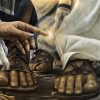


Because Someone Stayed
Following Jesus in the Ancient Art of Disciple-Making
John 8:12 • 1 John 2:6
“I am the light of the world. He who follows Me shall not walk in darkness, but have the light of life.” — John 8:12
“Whoever says he abides in him ought to walk in the same way in which he walked.” — 1 John 2:6
She was a Math major. I was a Religion major. And from the very beginning, she was better at this than I was.
I met Teresa at Messiah College. I won’t pretend the first thing I noticed was her theology. It was her — the way she lit up a room, the kind of warmth that makes strangers feel like old friends within minutes. But what moved me from captivated to convinced was something harder to name. Teresa had a way of living her faith so woven into ordinary conversation, ordinary moments, ordinary Tuesday afternoons, that you didn’t notice it was happening until you realized you’d just been loved in a way you couldn’t quite explain.
One of the teenagers in our early ministry years was a girl I’ll call Katie. She had grown up in the church but carried the weight of a broken home on her shoulders. When she got pregnant as a teenager, the unspoken question was whether the church would love her or quietly step back.
Teresa didn’t hesitate. She had Katie at our kitchen table for real conversation. She went grocery shopping with her. She held the baby so Katie could sleep. She didn’t offer a program or a pamphlet. She offered her life.
Katie is now married, raising children, rooted in Christian community, investing in the people around her — the way someone once invested in her. I am confident she made it because someone came alongside her instead of walking past.
Teresa was living something I didn’t yet have language for. It took years of studying the Gospels before I understood what she already knew intuitively: that following the Light means becoming the kind of person who illuminates every room you enter, every relationship you inhabit, every ordinary Tuesday you show up for.
This is discipleship. Not a course. Not a curriculum. A Math major who understood something the Religion major was still learning.
The Light That Walks
When Jesus said “I am the light of the world” in John 8:12, He wasn’t offering a metaphor for personal comfort. He was making a claim with enormous practical implications — and then immediately extending it to everyone who follows Him.
Light doesn’t hoard itself. It illuminates everything in its presence. And John would later make the implication explicit: those who say they abide in Jesus ought to walk as He walked (1 John 2:6). Not admire Him from a distance. Not attend services in His honor. Walk as He walked.
Which raises the question that every serious follower of Jesus eventually has to reckon with: what did that walk actually look like?
Not what we might assume from two thousand years of institutional Christianity. Jesus didn’t primarily teach in synagogues. He walked dusty roads. He shared meals. He asked disruptive questions in the middle of journeys. He was interrupted constantly and treated interruptions as the main event. He prayed before dawn. He wept at a graveside. He touched lepers. He noticed the people everyone else edited out of the frame.
The walk of Jesus was not a program. It was a life. And the invitation to make disciples of all nations is not finally an invitation to a strategy. It is an invitation to a way of being in the world that looks unmistakably like Him.
Teresa didn’t need anyone to explain that to her. She just lived it.
What Jesus Actually Did
Robert Coleman, in The Master Plan of Evangelism, identified what he believed was the central key to Jesus’ strategy: not the masses, but the few. Jesus concentrated His deepest investment in twelve ordinary people — not because He didn’t care about the crowds, but because He understood that lasting movements are built through depth, not breadth. Shallow contact with many will always be outrun by deep investment in a few who go and do likewise.
As Dallas Willard observed, Jesus’ aim in all He said and did was to enable people to live as He lived. That’s not a program. That’s apprenticeship. It’s the difference between handing someone a book about swimming and getting in the water with them.
His disciples didn’t sit in a classroom and then go apply their notes. They watched Him handle criticism, navigate conflict, respond to suffering, and prioritize the people polite society overlooked — all in real time, over three and a half years. They didn’t just learn His teaching. They caught His character. And that can only happen through life shared with life.
It’s worth sitting with that phrase: they caught His character. Not His content. His character. The transfer that matters most in disciple-making is not informational. It’s incarnational. You can fill someone’s head with theology and leave their soul untouched. But when someone lets you into their ordinary life — their kitchen, their car, their Tuesday afternoon — something else becomes possible. The way of Jesus gets lived in front of you. And slowly, if you’re paying attention, it begins to live in you.
That’s what Teresa was doing long before I had language for it.
The Problem We Won’t Admit
A 2015 Barna Group study, commissioned by The Navigators, found that roughly four in ten pastors have no one personally investing in their spiritual growth. Only one percent of pastors believe the church is doing “very well” at making disciples.
We are asking people to give what most of us have never received.
The programs aren’t the problem. Community formed around Scripture has shaped millions of lives, including mine. But when the Great Commission becomes something we manage instead of something we embody, information transfer replaces life transfer. And Jesus never made that mistake.
I have seen the patterns that pull us away — in churches I have served and in my own life. I’ll name them plainly.
The program trap. We’ve institutionalized something that was always meant to be relational. What Harvard researchers call “immunity to change” — the hidden commitments that quietly override our stated values — explains why most ministry leaders don’t lack desire; they lack the imagination to break free from the systems they’ve inherited. We know the program isn’t producing disciples. So we build a better program.
The expertise excuse. We wait until we feel qualified. Yet Jesus called fishermen, not experts. The woman at the well in John 4 has no theological training — her life is unambiguously still a mess — and Jesus sends her back into her town, where she ignites a movement. You don’t need to have arrived. You need to be honest about where you are and genuinely moving in the right direction.
The time myth. We tell ourselves we don’t have time. But Jesus made disciples while walking, eating, traveling, and attending weddings. Disciple-making doesn’t primarily require more time — it requires rethinking how we use the time we already have. Katie didn’t need Teresa to carve out a special hour in a formal setting. She needed someone at the kitchen table during an already ordinary day.
The task trap. This is the one I know best. I can become so focused on preparing talks or planning initiatives that I miss the person standing in front of me. My daughters call me almost every afternoon on their commute home from teaching. It is almost always inconvenient. I answer — always — but there are moments when the rushed tone in my voice says more than I intend. I have come to believe those calls are not interruptions. They are the work. God whispering: the people in front of you are the point.
The Cost of Staying
Authentic disciple-making — the Teresa-and-Katie kind — costs something real.
It costs time that could be spent elsewhere. It costs the comfort of managed relationships. It costs our image, because genuine investment in broken people means we’ll be seen with broken people, and some of them will make choices we can’t endorse. It costs our need to see quick results, because human transformation moves on a timeline that rarely satisfies our metrics.
And it costs something subtler: our need to be impressive. Modern ministry culture rewards platforms, reach, and influence. Jesus inverts the entire framework. “Whoever desires to become great among you, let him be your servant” (Matthew 20:26). The most effective disciple-makers I’ve known — and Teresa is chief among them — are almost never the most prominent people in the room. They’re the ones who notice the person everyone else walked past.
Henri Nouwen captured the spirit of this with characteristic precision. He spent the last years of his life not writing bestselling books or filling lecture halls, but caring for a profoundly disabled man named Adam at a L’Arche community in Toronto. People thought he had stepped off the stage. Nouwen understood that he had finally stepped onto it:
“Christian leadership is not a leadership of power and control, but a leadership of powerlessness and humility in which the suffering servant of God, Jesus Christ, is made manifest.”
John Chrysostom understood the same thing from the other direction. The fourth-century preacher was so gifted they called him Golden-mouthed — yet his most deliberate investment was not in his sermons but in the leaders he developed across the Eastern church. Men and women he personally mentored carried his influence into regions he never visited, across centuries he never saw.
The measure of a ministry is not what happens in the room where you are speaking, but what happens in the rooms you never enter — carried there by people you shaped.
Because Someone Stayed
I spent twenty-six years as a youth pastor. I had gifted volunteers, passionate staff, and more discipleship curriculum than I could fit on a bookshelf. But if I’m being honest with you — and I think an article about following Jesus probably requires that — Teresa was always, without question, the most effective disciple-maker in the room. Not because she had the best theology, though she does. Because she has the rarest of gifts: she makes people feel seen.
I don’t know the full reach of what Teresa did for Katie. I’m not sure I ever will. But Katie is now rooted in a Christian community in her town, loving a husband, raising children, investing in the people around her — the way someone once invested in her. That’s not a statistic. That’s a life. And that life is touching other lives in ways neither Teresa nor Katie could have planned or predicted.
This is how the light actually travels. Not through programs or platforms. Through people who have been loved, going and loving others. It’s what happened in the early church. It’s what’s happening right now in China, in Africa, in Latin America — wherever ordinary people take Jesus’ model seriously and simply refuse to stop.
C.S. Lewis wrote that he believes in Christianity the way he believes the sun has risen — not only because he can see it, but because by it he can see everything else. That’s the quality of light Jesus claims to be. Not a helpful addition to an otherwise well-lit life. The source of sight itself. And those who follow the Light are called to walk as He walked — to illuminate everything in their presence, every relationship they inhabit, every ordinary life they stay present in long enough to matter.
Teresa never had a title. She was just someone who stayed.
Your world is not waiting for a better program. It’s waiting for you.
Katie made it. Not because of a program. Because someone stayed.
Who is your Katie?

Bibliography
Biblical Sources
The Holy Bible, New International Version. Colorado Springs: Biblica, 2011.
Scripture references: John 8:12; 1 John 2:6; Matthew 20:26; John 4.
Research Sources
Barna Group in partnership with The Navigators. The State of Discipleship. Ventura: Barna Group, 2015.
Theological & Scholarly Sources
Coleman, Robert E. The Master Plan of Evangelism. Grand Rapids: Revell, 1993.
Kegan, Robert and Lisa Laskow Lahey. Immunity to Change. Boston: Harvard Business Press, 2009.
Kelly, J.N.D. Golden Mouth: The Story of John Chrysostom. Ithaca: Cornell University Press, 1995.
Nouwen, Henri. In the Name of Jesus: Reflections on Christian Leadership. New York: Crossroad, 1992.
Willard, Dallas. The Divine Conspiracy. San Francisco: HarperSanFrancisco, 1998.
Spader, Dann. The Shared Ministry Philosophy of Concentric. ConcentricGlobal.org/resources.