
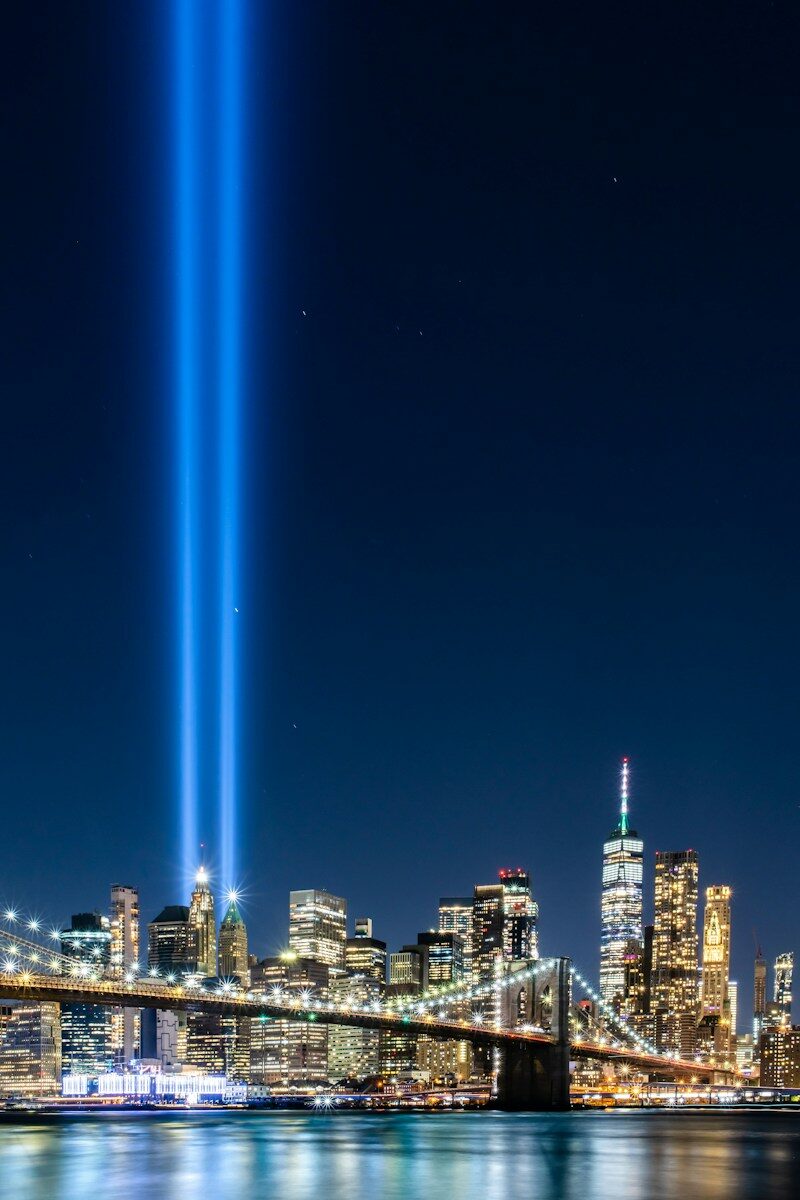
I Remember: What Would It Mean to Remember 9/11 Faithfully?
A Note to My Friends: This reflection is written primarily to my friends in the United States, as we pause on this 25th anniversary to remember. But the longings I describe, the truths I seek to share, and the invitation I extend apply to all of us, regardless of where we call home.
Where I Was
I remember. I remember where I was, what I was doing, who I was with. I remember the phone call from my sister Anneliesa.
Serendipitously, or perhaps providentially, I was home with Teresa just returning from our 5k run. It was Tuesday morning, my day off. The phone rang. Our power was out for unknown reasons, so we couldn’t turn on the news. But as I answered, my sister’s voice came through with words I’ll never forget: “We are under attack!”
I asked what she meant. She told me about the World Trade Center. A plane had flown into the first tower. Then, almost incomprehensibly, a second plane into the other. Then the Pentagon. Then a plane downed in Shanksville, Pennsylvania.
What was happening?
We left our dark home to find a TV. The first place we thought of was a nearby McDonald’s. We sat with strangers, holding coffee, watching the screen in silent horror as our nation was attacked before our eyes.
A Moment of Reckoning
250 years of a nation built on the sacrifice of those who fought for freedom, and 25 years since we were reminded again of what freedom costs. A quarter millennium of American history, and then a quarter century ago, we watched innocents taken from us in an instant. Together, they create a kind of bookend moment for reflection: not just on what happened on that Tuesday morning, but on what we have been, what we have sacrificed, and what we are called to be.
Both anniversaries ask the same question in different ways: What does it mean to be faithful stewards of the freedom we have been given? What do we do with the inheritance of those who came before and the memory of those we have lost?
Why This Matters to Me
I had lived in New York as a child walking the streets of Manhattan and attending PS-41. I grew up as an adolescent in the North Jersey suburbs, near the shadow of those towers. I had friends and family who lived near the Twin Towers, some who worked in them, and family who worked at the Pentagon.
When the stories came in, both from media and from phone calls, it was sobering in a way that statistics can never capture. These weren’t abstract numbers. These were people. People I knew. People’s families. People with breakfast planned that evening, children who expected them home, dreams and hopes and ordinary lives that were simply extinguished in an instant.
The weight of that reality still sits heavy with me twenty-five years later.
We gathered for prayer in our community and at LCBC Church in Manheim. We stood on the town square, and people came. Some to church services for the first time in years. There was a spiritual hunger I had rarely witnessed. There was also a profound unity. Republicans and Democrats stood together. Neighbors helped neighbors without asking whether they voted the same way. People stopped arguing about politics because they were confronted with something larger than their disagreements.
For a moment, we remembered that we are all human. Vulnerable. Fragile. In need of God and of one another.
What We Learned
In those days and weeks following, something shifted across America. People looked to God in a more earnest, attentive manner than I had seen in my lifetime. American flags flew outside homes. There was a return to church from the disengaged. People returned to seeking spiritual answers for the uncertainties and violence overwhelming our world.
They sought comfort. They sought answers. They sought peace: not the shallow, flickering peace of distraction, but the deep peace that can only come from outside ourselves; transcendent peace.
I wondered: Would this be our moment of renewal? Would we, as a nation, wake to something deeper? For a time, we did. We saw glimpses of revival. We saw neighbors helping neighbors. We saw people reaching beyond themselves.
We remember the 343 firefighters and 71 law enforcement officers who ran toward danger with countless other volunteers. We remember the passengers and crew of Flight 93 who learned of the other attacks and chose to fight back, laying down their lives rather than allowing more innocents to be killed. We witnessed sacrifice. We witnessed extraordinary courage. We witnessed nobility.
And the world saw it too.
What We Forgot
But then, as often happens, things returned to normal. We moved on. The American flags came down. Church attendance declined. The sense of urgency faded.
We are a forgetful people. Not just in America but across our world.
We have forgotten the sacrifice of others made on our behalf. We have forgotten the cost of war, of violence, of the breakdown of compassion for the hurting, the wounded, the vulnerable. We have forgotten that choices have consequences, that extremism born from hatred, from dehumanization, from a failure to see the image of God in others, leads to unspeakable destruction.
And this forgetting is not merely historical. It is spiritual.
We live as though the violence and brokenness we see in the world simply happens, like weather: terrorism, polarization, addiction, depression, despair. As though it emerges from nowhere. As though we can manage it by policy alone, or police alone, or better security systems alone.
But I want to speak to something my skeptic, doubter, and hurting friends might not expect from a Christian: I believe we have misidentified our real enemy.
The Real Enemy
Our struggles are not ultimately against flesh and blood.
Listen to what Paul writes to the church at Ephesus: “For our struggle is not against flesh and blood, but against the rulers, against the authorities, against the powers of this dark world and against the spiritual forces of evil in the heavenly realms” (Ephesians 6:12).
This isn’t mysticism or superstition. This is wisdom.
When we look at September 11, we see terrorists. We see murderers. And yes, we see those things. But beneath the hatred, the rage, the willingness to kill the innocent, there is something deeper at work. There is a spiritual rebellion against goodness, against peace, against the image of God in all human beings, against God Himself.
Jesus called this rebellion’s leader ‘the father of lies’ and ‘a murderer from the beginning’ (John 8:44). Scripture portrays this enemy as one whose purpose is to steal, kill and destroy (John 10:10). This is the real enemy. Not immigrants. Not people of different faiths. Not those who vote differently than we do. Not people in other nations. The enemy is the force of spiritual rebellion that works to dehumanize, to divide, to breed hatred and fear.
The Path Forward
After decades of walking alongside Christian leaders in countries experiencing war, terrorism, poverty, persecution and deep political division, I have become more convinced than ever of something: lasting peace requires more than military strength or political victory. It requires transformed hearts.
I was reminded of this when I heard retired Green Beret Lt. Col. Scott Mann speak about the power of human connection and relationship in times of crisis. His experience reinforces something I have seen repeatedly around the world: relationships matter. But that connection cannot emerge from policy or firepower alone.
This does not diminish the role of security. We need military strength. We need diplomacy. We need wise policy. We need courageous first responders and effective law enforcement. These things matter. They can restrain evil and protect the vulnerable. But they cannot transform the human heart.
Only God can do that.
This is what both the believer and the skeptic might agree on: we need peace. Peace in America. Peace in our world. We need unity in our land. We can pass laws. We can build walls or tear them down. We can increase security. We can win elections and advance our preferred policies.
But we cannot change the human heart through any of these means.
True peace only comes as we surrender to something deeper than ourselves. As we allow ourselves to be transformed by love itself. As we learn to love the Lord our God with all our heart, soul, and strength, and to love our neighbor as ourselves (Matthew 22:37-40).
This is not naive. It is not weak. It is, in fact, the most radical and difficult thing any of us can do.
Think about it: It is easier to hate than to forgive. It is easier to build walls than to build bridges. It is easier to assume the worst about those who are different from us than to listen to their story. It is easier to protect ourselves than to risk ourselves for others. It is easier to demonize those who disagree with us than to see the image of God in them.
But Jesus didn’t call us to what is easy. He called us to transformation. He called us to become people who love even our enemies (Matthew 5:44), who bless those who curse us, who turn the other cheek not because it’s effective strategy but because it breaks the cycle of retaliation and revenge.
For the skeptic or doubter, I would ask: What if he’s right? What if this ancient Middle East carpenter was onto something about how the world actually works? What if peace doesn’t come through more weapons or more walls, but through the slow, difficult work of reconciliation and the transformation of human hearts?
The Hope
The prophet Isaiah spoke of One who would come as the “Prince of Peace” (Isaiah 9:6). Not a military conqueror. Not a political leader. But one who would rule with justice and righteousness, and whose government would never end.
That’s Jesus.
When He rose from the dead, He didn’t come back to take revenge on those who crucified Him. He came back to offer forgiveness. He appeared to the disciples and said, “Peace be with you” (John 20:19). And then He commissioned them to bring that peace to the world.
Later, Paul would write about a peace that “transcends all understanding” and “will guard your hearts and your minds in Christ Jesus” (Philippians 4:6-7). Not the absence of pain or difficulty, but the presence of deep assurance that we are held, loved, and ultimately safe in God’s hands.
Through Christ, all things are being reconciled (Colossians 1:19-20). Not just some things. Not eventually, in some distant heaven. But now, through the work of the Spirit, transformation is possible. Reconciliation is possible. A new way of being human is possible.
This is what our world desperately needs. Not more information or technology. Not more security or military might. But transformation. Spiritual awakening. The return of the church to its true mission: to embody the love of Christ, to pursue peace, and to invite others into a kingdom that operates on radically different principles than the kingdoms of this world.
A Note to My Global Friends
And to my friends around the world: I know September 11 is not your story in the same way it is ours. For many of you, however, the realities we remember today are not history. You live with war, terrorism, displacement, persecution, political violence and fear in ways many Americans cannot fully imagine. You have taught me that the longing for peace is not an American longing. It is a human one.
The hunger to be safe. The desire for justice. The need for hope. The longing to see your children grow up without fear. The dream of a world where people of different backgrounds can live together without violence. These longings belong to all of us, in every nation, on every continent.
So this isn’t only a message to America. It is a message to all of us. Whoever you are, wherever you live, whatever you have experienced, the invitation is the same: Come to the One who loves you absolutely and completely. Come to the source of true peace. Come and be transformed.
Closing
So today, we remember.
We remember those who died. We remember those who ran toward danger. We remember families whose lives were changed forever. We remember the unity we experienced, even if only for a season.
And we remember what Jesus taught us: that the answer to hatred is not more hatred, that the answer to dehumanization is to see the image of God in every person, and that true peace begins when hearts are reconciled to God and to one another.
Twenty-five years later, may we not simply remember what happened. May we remember what we learned.
May we choose courage over fear, compassion over contempt, reconciliation over retaliation, and love over hatred.
And may we place our ultimate hope not in our politics, our power, our security, or ourselves, but in the One who called Himself the Prince of Peace.
We remember. And we pray.

(For those interested, I highly recommend Lt. Col. Scott Mann’s Operation Pineapple Express.)